Showing posts with label vegetarian. Show all posts

Sunday, 21 June 2015

Kala Channa Masala

Kala Channa Masala

My life might be easier if I owned a pressure cooker.  But when I read horrifying descriptions of the disasters involved with them, I just plan well ahead.  If you own a pressure cooker, you can make this dish much more quickly than I can manage.

Kala channa isn’t the usual chick pea we see in cans.  It’s a different variety, and I’m told it’s higher in nutrients, especially iron.  Its flavour is a little different than the usual channa, and it’s a bit more heavily textured.  So far, I’ve seen the pea available only in the dried form, but I’m happy to put in the time required for this dish.  Plan to make this two days ahead of eating, if you use a slow cooker.  You don’t need to be chopping and stirring for the entire time; you just need to get started early.  This recipe makes a big pot of channa masala.

4 cups dried kala channa beans
Water to cover and leave lots of room

1 tablespoon cumin seed
½ teaspoon black ajwain
1 teaspoon black peppercorns
1 teaspoon fenugreek seed
3 black cardamom pods
Cool roasted spices before buzzing.
5 cloves
1 dried Kashmiri chili
1 tablespoon coriander seed
2 large sticks cassia or cinnamon
1 teaspoon turmeric powder
½ teaspoon amchur powder 

2 tablespoons mustard oil
½ teaspoon cumin seed
½ teaspoon mustard seed
1 large red onion, diced 

3 large fresh tomatoes
8 cloves garlic
2 inches ginger
2 Serrano peppers

1 bunch fresh cilantro
Water for blender
1 teaspoon salt, possibly more
2 tablespoons jaggery powder, or to taste
2 to 3 tablespoons heavy cream, or to taste

Two days ahead of serving, soak the kala channa overnight in water.  Be sure to not just cover the channa, but leave another two inches of water for headroom.  These beans will swell up somewhat.  The next morning, drain and rinse.

In a slow cooker, add the channa and lots of water, again, leave at least two inches of headroom, possibly more.  The beans won’t swell much more, but the beans need to be left for 24 hours worth of cooking on ‘high’ heat (a slow cooker isn’t very hot).  You will need a lot of water for this duration of time.  After they’ve cooked for about 24 hours, turn off the heat and let rest till you’re about to cook these up.  I’ve frozen surplus cooked beans before, so I have them ready when I need them.

About three hours before you need to serve these, dry roast your dry whole spices.  In a heavy and large saucepan, place all the spices except the turmeric and amchur.  Put on medium high heat, and jiggle the pan while you’re watching the progress.  A little smoke and nice fragrance is all you need, then brush them into a spice grinder, along with the turmeric and amchur.  No need to buzz just yet.  Set aside to cool. 
Slice this way, then cross ways for fast dicing.

Meanwhile, add the mustard oil to that saucepan.  Turn heat onto medium high, and when oil is hot add extra cumin seed, then mustard seed.  These will splutter and pop a bit, so within moments, add the onion and stir.  Reduce heat to medium.  Cook till onion is transparent and partially caramelized. 

While the onion is cooking, toss the tomato, garlic, ginger and peppers into a blender.  Buzz to a smooth liquid.  Set aside.  Buzz the spices to a fine powder, and add to the cooking onion.  You may need to add additional oil so the spices can cook more easily.  Stir and cook for a few minutes.  

Have the saucepan lid handy.  Quickly add the buzzed tomato mixture and cover.  Set the blender aside to fill with more water and cilantro for later.  (No use letting those good garlic and chilli flavours get washed away.) 

Cook the tomato and onion mixture till it’s no longer boiling and spitting furiously.  Once it's safe, open the pot and add the cooked channa.  Add more blender water at this point, if needed.  Cook for another hour and a half or so.  Put the fresh cilantro, stems and all, into the blender and add enough water to buzz it into a green liquid.  Add that to the channa.  Add more water if the mix is too thick.

Continue to cook on medium high heat.  In the last half hour of cooking, add salt to taste.  Add jaggery if needed.  (I found my masala tasted quite sharp, so I needed the jaggery.)  Add cream a few minutes before serving.  Adjust for salt, jaggery and cream flavours, then serve with rice or chapattis.  (I served with both!)  

This recipe makes a fabulous main course, when paired with either rice or whole wheat chapattis, and also makes a great side dish to go with butter chicken, kerela and sag paneer. 


I’m happy to plan ahead, but I wonder, should I bite the bullet and buy myself a pressure cooker? What do you think?  Please drop me a line. 

With butter chicken, kerela, sag paneer and basmati rice.  Chapatties were all eaten by clicking time.

Sunday, 21 December 2014

Masoor Dal with Kale, Mint and Cilantro

Masoor Dal with Kale, Mint and Cilantro

I will confess to substituting meals lately with Christmas gingerbread and nuts-and-bolts.  I am beginning to crave a vitamin, or two.  While lentils and kale don’t sound like a fair comparison to gingerbread pastries, they too can be made delicious with enough ginger, garlic, chilies and perhaps a little butter.  After all, we can’t live on just Christmas treats.

The spice blend for this dal has its own complexity, but the addition of tons of fresh mint and cilantro kick this dal up many notches.  This cooks within the hour, and can easily serve four to six, especially with basmati rice or chappatties.

2 cups masoor dal
water to wash, then fresh water to cover

5 Kashmiri dried chilies
Gently roast till they barely smoke.
1 tablespoon cumin seed
1 tablespoon coriander seed
1 teaspoon fennel seed
1 teaspoon black ajwain (black celery seed)
1 teaspoon fenugreek seed
3 cloves
1 teaspoon black peppercorns
2 black cardamom pods, well bashed, husks removed
1 green cardamom pod, bashed, husk removed
1 small flake mace
3 pieces cassia 

1 teaspoon ground turmeric
Wash and remove mint stems!

2 tablespoons canola oil
1 extra teaspoon cumin seed
1 large red onion, sliced into thin but short pieces
2 inches ginger, matchsticked
1 teaspoon extra oil, ghee or butter
1 can tomatoes (28 ounce size)
7 garlic cloves
2 fresh chilies, or more to taste
4 kale leaves, ribbed and chopped
3 cups fresh mint
3 cups fresh cilantro
salt to taste

Wash the dal till the water comes clear.  Cover with fresh water, and bring to a boil.  Lower to simmer and cook till soft.  Masoor Dal, the orange lentils, cook up in about fifteen to twenty minutes. 

Chop cilantro leaves with tender stems.
While the dal is beginning to cook, roast the first set of whole spices in a large pot, (but reserve the extra cumin seeds.)  When they start to smoke and fill your nose with fragrance, pluck out the cassia pieces, and brush the rest of the roasted spices into a grinder, adding the turmeric.  Set aside to cool.

Add oil to the big pot, and return cassia to the pot.  Set on medium high, and when the cassia starts to sizzle a bit, add the remaining cumin seed.  Let that sizzle for a few moments, then add the onion and ginger.  Turn heat down to medium, stirring, and let cook till onion is translucent and golden. 

The spices need the extra bit of oil, ghee or butter.
Grind the warm spices to a powder.  Add them to the onions, with a bit more oil, ghee or butter, if you prefer.  Stir and cook the spices for two or three minutes.  In the meantime, place canned tomatoes, garlic cloves and fresh chilies into a blender and buzz till smooth.  With a closefitting lid nearby, pour the tomatoes into the onion mix and quickly cover. 

Let cook till it sounds like the furious boiling has settled a bit.  Carefully lift cover and add the cooked dal.  Add the kale, stir, and cook another twenty minutes.  This is a good time to wash the mint and pluck the leaves from the stems.  The stems are too wiry to cook, so remove them carefully. The cilantro needs a good wash.  Trim just the nubby ends of the cilantro stems.  Chop the cilantro, leaves and tender stems.  

Once the kale is almost tender enough to eat, add the mint leaves.  Cook about five to ten minutes then add the chopped cilantro.  Taste for salt and add now.  Cook for just a few minutes, to keep cilantro as green as possible.

Serve with basmati rice or chappatties, and contratulate yourself for rescuing yourself from malnutrition.  After eating silly junk for several days in a row, this will taste magnificent.  But don’t get too self-righteous, because next up will be my Christmas Crack recipe, made with unusual ingredients, of course. 

This will tide you over till you get into the Christmas Crack...

Sunday, 16 November 2014

Almond Masala Stew

Almond Masala Stew with a chapatti and a bit of plain yogurt

Are you frantically hungry and wanting something delicious in a big hurry?  Within fifteen minutes you can be munching on this vegan delight, or perhaps vegetarian, if you add a little butter or cream. Spicy, filling and healthy, it will warm you completely on a cold winter’s day.

The only hitch is that the basis of the stew is my Emergency Masala Tomato Sauce, which you really should have in large quantities in your freezer.  Failing that, I suppose you could make a facsimile with a jarred tomato sauce that you doctor up by frying onions and  garam masala, then dumping in the sauce to heat through.  But don't get me started on factory foods...

You can serve this with rice, but start beforehand, because this almond recipe will be done before the rice is cooked.

½ cup almonds
2 cups emergency masala tomato sauce (frozen is ok)
1 bunch of spinach leaves (or a box of frozen) (optional)
1 small splash of water, if needed
1 tablespoon whipping cream or butter (so optional!)

Toasting almonds takes just a couple of minutes.
Toss the almonds into a blender and buzz for about thirty seconds.  A combination of powder and bits will provide the right taste and texture.

Put a non-stick sauce pan on medium high heat.  Add the almonds.  (I later use that almond powder left in the blender for warm almond and cardamom milk, but that’s another recipe.) Using a rubber spatula or wooden spoon, stir the almonds around for a couple of minutes to ensure they get toasty and golden, then add the sauce. 

If the sauce is frozen, keep the heat high, and stir and flip over occasionally to help thaw.  You may want to add a couple of spoons of water if there’s a danger of the almonds burning if the sauce isn’t melting fast enough.  If you’re using frozen spinach, add it while tomato is still frozen.

Keep the tomato sauce boiling till it’s reduced and somewhat thick.  If fresh spinach is desired, add it late in the process to keep it green. Spinach takes less than five minutes to heat through and soften up slightly.  If you’re going to indulge in cream or butter, add just before serving, giving it just time to warm through.


Fifteen minutes later and you’ll be experiencing heaven.  This makes a great breakfast, lunch or light supper.  If you haven’t started a batch of Emergency Masala Tomato Sauce, do it now!  Recipe for butter chicken will be coming along soon, and you’ll need it for that too! 
Another time I omitted the spinach but served it with kerela, curd and a chapatti. Another delicious lunch for me!

Monday, 10 November 2014

Emergency Masala Tomato Sauce

Emergency Masala Tomato Sauce makes a great vegan almond stew!

You never know when you’re going to be too lazy to cook, so when you have some extra tomatoes and extra energy on hand, get to work!  I made and then froze this sauce about a month ago, when my home grown tomatoes had ripened and were lingering in my basement.  You can make this sauce with any fresh or canned tomatoes.

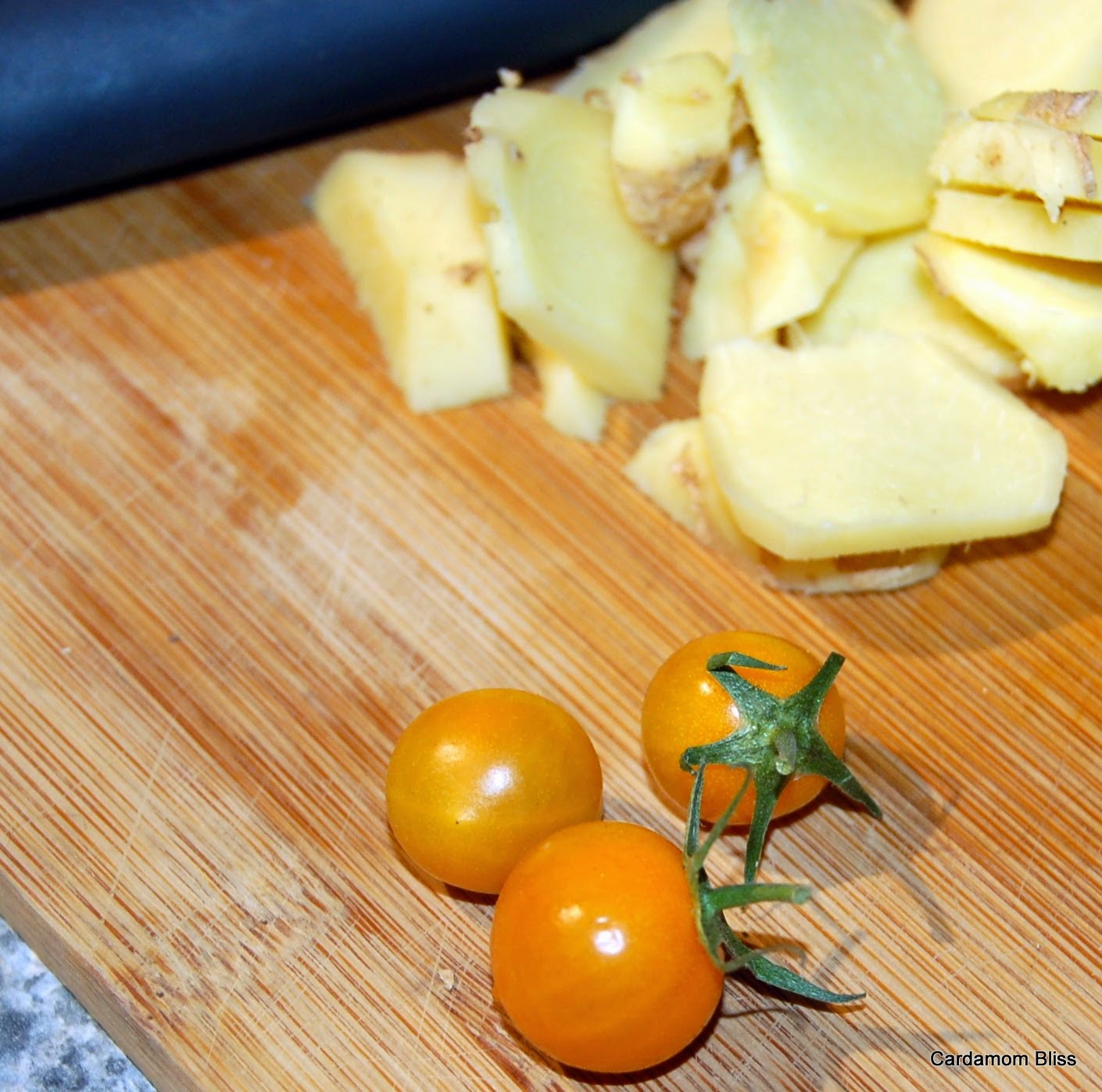
I had a lot of tomatoes that needed to be used up, and many of them were the super sweet Sun-Golds.  If your tomatoes don’t have this sweetness, I’d suggest adding a tablespoon or so of brown sugar, or jaggery (raw Indian cane sugar) if you have it. 
These were ripe and had to be used fast!

My recipe made about sixteen cups of sauce, but that’s because I had so many tomatoes.  You can make this in smaller quantities.  It took about two and a half hours to make, from start to finish, and much of that involved me reading and talking on the phone. 

2 sticks cassia
2 Kashmiri dried chilies
1 heaping tablespoon cumin seed
1 heaping tablespoon coriander seed
1 teaspoon black peppercorns
½ teaspoon fenugreek seed
½ teaspoon black cumin seed
¼ teaspoon mace flakes
1 teaspoon fennel seed
4 green cardamom pods, crushed with husks removed
1 black cardamom, crushed with husk removed
1 heaping teaspoon ground turmeric

2 tablespoons good vegetable oil
1 teaspoon cumin seeds
½ teaspoon mustard seeds
2 large red onions, diced
1 shopping bag full of ripe tomatoes (gathered from the greenhouse, then the basement ripening floor), or the equivalent, or many less if you can divide the amounts below…
1 head garlic, broken apart, ends trimmed and most of paper and debris removed
2 inch stem ginger, roughly sliced
2 fresh hot chilies (or to taste)
salt (to taste)
1 tablespoon brown sugar or jaggery if your tomatoes aren’t sweet enough (taste first)

Over the next few months I expect to use much of this sauce as the basis for my beautiful granddaughter’s favourite, butter chicken.  With her in mind, I kept the chilies at the mild level.  If more daring types eat your cooking, increase the heat factor.  (You can always add extra chilies while you’re reheating this, remember!)
Sun-Golds, eventually stemmed, with roughly cut ginger

Start by roasting your whole spices.  Use the large pot you’ll be cooking the sauce in.  Scatter the spices over the bottom of the dry pan, and roast on medium high heat, shaking the pot a little, till they smell gorgeous.  Remove from heat.  Pluck out the cassia sticks and load all else into spice grinder along with the turmeric powder.  Set aside to cool.

Put the pot back on the heat and add oil and cassia sticks.  When hot, add the cumin and mustard seed.  As soon as they splutter and shift colour, add the onion.  Reduce heat to medium, and cook till onions are translucent and golden at the edges.

Here we have a lot of sauce coming up!
Meanwhile, load tomatoes, ginger, chillies and garlic into the blender.  (I trim the hard ends of the garlic and remove most of the paper and scraps, but I’ve been assured the closest paper on the garlic cloves enhances their flavour.) Buzz till smooth, which should take a couple of minutes.  I had two blenders worth of tomatoes, so I did this in two stages. 

Once you have a blender’s worth of pureed tomatoes, grind the spices till they’re powdered, and add to the onions.  You may need to add a bit more oil if they’re too dry.  Fry for a couple of minutes.  With the pot lid handy, add the pureed tomato mixture.  Quickly cover the pot.  While the first load bubbled and sizzled away, I pureed my next batch of tomatoes and flavourings.  This sauce bubbles up like lava, so be careful about opening the pot till it’s settled down.  Add all tomatoes, and rinse  blender with a little water into the pot to get every last tomato molecule.   Taste. Mine was a little too acidic, so I added about a teaspoon of sugar, but you may want more if you aren’t using super sweet tomatoes.
This will need to cook a while, being stirred occasionally.

Cook for about an hour and a half, till the oil separates a bit.  Stir from time to time.  Read the newspaper. Chat on the phone.  Take off heat, let cool and then freeze what you don’t use immediately. 

I’ve been making a quick and easy vegan almond stew with this sauce, to be explained soon.  Super easy butter chicken will also be on the menu.  Stay tuned.


I, for one, will remain undaunted by this cold and snowy weather which induces horrible laziness on my part. This beautiful sauce will make many quick and delicious meals that will keep us warm, satisfied and toasty. 

It's ready when it's reduced and looks gorgeous!


Saturday, 13 September 2014

Loving Kerela

Kerela, mushroom and paneer masala

A few months ago I wrote about learning to love kerela, that strange vegetable that looks like a mad scientist’s experiment with a fish and a mouse.  I have since become enamoured of kerela, to the near point of addiction.  This vegetable, chock full of nutrients and healthy enzymes, is not for the faint of heart.  The bold taste of kerela is acquired, much like the taste for strong olives. 

This morning I was compelled to make it for my breakfast, I am that enamoured.  This amount is enough for three meal sized servings, or a family amount if served as a side dish.  Preparation time is about an hour and a half.

3 kerela, sliced
3 tablespoons coarse salt
2 tablespoons healthy oil (I used avocado oil)
1 teaspoon cumin seed
½ teaspoon fennel seed
1 cinnamon stick
1 red onion, quartered and sliced
2 slices of ginger from the thickest part of the stem, matchsticked
2 chillies(or to taste) , finely chopped
1 tablespoon garam masala
¼ teaspoon powdered mace
10 mushrooms, sliced
2 garlic cloves, sliced

1 tablespoon pomegranate molasses
a few splashes of water
½ cup diced paneer (Indian cheese available in South Asian aisles or markets)

Start early by slicing the kerelas into rounds.  You’ll see I have not removed the core.  Now I like the flavour too much, and I adore the crunch of the seeds.   Place slices onto a salted plate, and sprinkle more salt on top.  The salt helps to draw out some of the punchy bitterness, even though this dish will still have a strong punch. Set aside for an hour.
sliced kerela
Slice and salt an hour beforehand.

In a large frying pan, pour in oil and put on at medium heat.  Add the cinnamon stick, cumin and fennel seed and when fragrant, add onion and ginger.  

Cook, stirring occasionally, till the onion is translucent and starting to get golden.  Add the garam masala and mace and maybe a bit more oil if needed.  Fry for a minute or so, then add the mushrooms.  Space them out and let them get as much contact with the frying pan as possible so they get the chance to become golden and caramelized.  

Within about five minutes, stir in the garlic and continue to cook till mushrooms are mostly browned.  Add the pomegranate molasses and about a tablespoon of water if pan seems dry. 

Meanwhile, put those kerela slices into a colander and rinse well.  (They will still have a salty taste, so no need to add extra salt to this dish.)  Toss into the frying pan along with paneer.  Check for moisture again, adding another splash of water if the mix looks dry.  Cover and cook another ten or fifteen minutes on medium heat, till the kerela are soft.  
kerela
Does this look like a science experiment to you?  Mouse and fish combo?

I served these with a bit of yogurt and a chapatti, as I was feeling sorry for myself this morning.  (I had forgotten to buy milk for my morning coffee.)  

I don’t usually get so elaborate for my breakfasts, but this also served as my dinner tonight, and will serve again as breakfast tomorrow morning.  


I will again say this vegetable is for the honest and the bold.  If an olive is too much for you, this dish will finish you off.  But if you are stout hearted, enjoy!

Kerela, kurd and chappati breakfast
The yogurt tones it down a bit, and adds extra calcium and protein.

Tuesday, 29 July 2014

Wilma’s Miracle Cheese Biscuits

Wilma's Miracle Cheese Biscuits (spicy version)

I’ve been making baking powder biscuits since forever, and never knew they could be this easy.  When Wilma set these out for the bookclub ladies, and told us how she’d made them, I thought she was forgetting a few ingredients.  She later emailed the recipe, and I was still doubtful till I tried them myself.

As usual, I’ve dolled them up with chilies and herbs, (my additions are in Italics) but I’ll list the basic ingredients first, so you can see how ridiculously easy these are.  I’m contemplating a sweet version to use for a shortcake recipe, but that’s for later this week.  For now, we’re sticking with this flavourful and spicy version. 
Mix dry ingredients and cheese with a fork.
  
These take about forty-five minutes, from when you begin assembling ingredients to when you’re popping these lovelies into your mouth.  This recipe makes about eight biscuits, but it can be doubled.  Bake at 400 F.

1 cup flour  (use whole wheat)
1 cup grated sharp cheese  (use a good one)
2 tsp baking powder
2 garlic scapes, chopped (scallions would be good too!)
two stems cilantro, chopped
1 chili, finely chopped
½ teaspoon chili flakes
1 tablespoon black poppy seeds
a pinch of Kosher salt
1/2 cup ice cold water
1 tablespoon (plus) butter for greasing cookie sheet

Once well mixed, add the ice-water but don't stir too much.


Preheat the oven and generously butter a cookie sheet. Leave bits of butter here and there.  

Combine the dry ingredients with a fork.  Add the ice-water, and stir just to combine.  You can use a spoon to drop the dough onto the cookie sheet, or use your hands, like I did.  Bake at 400 degrees F for eight to ten minutes.  Cool on the sheet for a couple of minutes, then move to a rack to cool a bit more.


Serve warm or chilled, either way you'll love their flavourful cheesiness, and be congratulating yourself on how easily these are made. 
I moved these bits of butter closer to the dough. Yummmm

I made a batch over the weekend, and have been pretty much living on them.  Delicious with a cup of strong milk coffee for breakfast, but great with eggs bhurji too!

Great with more garlic scape eggs bhurji...

Saturday, 8 March 2014

A healthier masala dosa!

a healthier masala dosa

This crispy thin crepe filled with a spicy vegetables is a South Indian standard, but as usual, I’ve rejigged it.  Normally the mixture is curried potato chunks, but I’m inclined to find that a little too carby.  The crepe itself is made from a blended rice and bean batter, so I think enough already with the carbs, although many will disagree, I know.

The batter itself takes time to create, so thinking ahead is a must.  First the rice and beans have to be soaked overnight, then blended into a paste, then left to ferment for another eight or so hours.  The filling can be whumped up pretty quickly though, so although time is involved, the preparation isn’t challenging. This recipe makes about 8 servings.
Made a great party dish with some bubbly!

Changing the subject entirely, I’m thinking of a dinner party where it seemed that hot dogs were the main course.  Our hosts brought in a huge platter of them, along with unusually delicious accompaniments like guacamole, chopped tomato and excellent shredded cheese.  I wolfed down three, since the trimmings were so good.  To my chagrin, when I’d finally finished shoving them down my throat, the hosts brought out an even bigger platter heaped with the most delicious steaks I’d ever eaten.  Who knew they’d considered the hot dogs as a side dish?

I think of this dinner party because I pulled a similar stunt with Allison and Rita.  Only in my case, it was masala dosa and a roast chicken with a rosepetal masala.  Masala dosa is considered a light main dish on its own, but I figured I could get away with it, since neither Allison nor Rita have been to Southern India, well at least not that part of Southern India, and I knew that Rita would be especially hungry.

The Batter
¼ cup urad dal (a special black bean from India, not to be confused with other black beans)
¾ cup basmati rice
water
1 teaspoon fine fenugreek seed 
Dosa batter
Use a blender for a smooth batter.

The Filling
1 tablespoon ghee, or vegetable oil
1 teaspoon cumin seed
½ teaspoon mustard seed
2 potatoes, cubed into small pieces
1 small onion, finely diced 
1 inch fresh ginger root, finely sliced into matchsticks
1 tablespoon garam masala or a favoured prepared masala
1 bunch asparagus, trimmed and sliced into one inch lengths
1 cup cottage cheese
1 cup arugula or spinach leaves
½ lemon, juiced

If I were making this just for my own self, a few fresh chilies would have gone into this as well, but I was reluctant to blow my friends’ ears off their heads, so I kept this mild. 

spreading the dosa batter
The tricky part, spread it into a big thin circle!
First, soak the rice and dal in two separate containers.  Be sure you use enough water to keep both completely covered, even after they’ve swollen a bit.  Put in a safe place over night. 

In the morning, start the oven.  Once it’s begun to warm up, but is still below 100 F, turn it off and turn on the oven light.  Combine the rice and dal into a blender and drain the water.  Rinse and drain until the water runs clear.  Add fresh water to the 750 ml mark.  Blend for about five minutes, till the rice and dal are completely pulverized into a smooth batter.  Add the fenugreek seed, pour into a glass container with a cover, and set into the warm oven.  Leave to ferment, about eight hours.  It will get fizzy and bubbly.  At this point, I refrigerated my batter for using the next day, but you can use it immediately.

Cottage cheese, asparagus and arugula are healthy additions!
For the filling, put ghee or oil into a good sized non-stick sauce pan.  Turn heat to high, and add cumin and mustard seed.  They will splutter.  This takes mere seconds.  As soon as the mustard seed is mostly grey, add the diced potato.  Turn heat to medium and continue to brown and cook the potato.  Add the onion and ginger, (and chilies if you’re using) and continue to cook, stirring from time to time. 

Because I was also making the rosepetal masala roasted chicken, I roasted potatoes around the chicken.  When the chicken was done, I removed the potatoes, chopped them, and added them to the ghee.  Because I was using partially cooked potatoes, my dish didn’t take long to make.  If you’re starting with raw potatoes, check for tenderness.  Once tender, turn on the heat under a non-stick griddle to medium high. 

Make the crepes, then fill for serving at once.
As the griddle is heating, add the asparagus to the potatoes, stir and cover.  Let cook about five minutes.  Add the arugula and cottage cheese, stir again, cover and cook for another five minutes.  Remove from heat.

Now come the dosa shells.  Pour a ladle’s worth of batter into the centre of the griddle.  Use the back of a large wooden spoon to smooth the batter, moving in a circle, till the batter is spread in a larger, thin circle on the griddle.  This tricky step happens fast!  Have a flipper handy, but don’t pry at the crepe until you see it’s starting to lift itself from the griddle.  When you can slip the flipper under the crepe, flip it and cook the other side.  Set on a plate.  (I made three crepes in a row, so we could all eat at the same time.) 


Rosepetal Roasted Chicken, masala dosa and bubbly for an elegant ladies' lunch!
Pour the lemon juice over the filling, stir and load into the centre of the crepe.  Roll, turn over, and serve.  We had this with the rosepetal masala roasted chicken, and some bubbly.  For dessert, floral blueberry crumble. 

Because of the chicken, we really didn’t need the additional protein in the cottage cheese, but if you’re being sensible, and serving only the masala dosa for a meal, do add the cheese and as many greens as you can.  You’ll have a much healthier version of this wonderful South Indian dish. 

Sunday, 24 November 2013

Channa Masala with Red Capsicum


It’s true.  I buy chickpeas by the case.  They are my favourite legume, and I’m more than happy to have them breakfast, lunch and dinner.  Combined with some rice or chapatti, they also make a great protein, and they’re high in fiber and generally fabulous all around, ideal for vegetarians and vegans.

Red capsicum, or sweet red peppers, are another favourite.  The long pointy ones seem to have the best flavour, although that could be my greed speaking, since they’re the biggest.  I buy lots at a time, and use them in so many recipes.  (I've tried to give a link for my red pepper search results, but it's not working.  Use my search bar and type in red pepper.  You don't want to miss the red pepper dip!)  I also love to slice them in lengths, and use them like chips for guacamole, a delicious but healthy treat.

This channa masala recipe is fairly easy, involving about twenty minutes of preparation, and at least an hour of cooking time.  It makes a goodly pot that will serve at least six people their main course. 

1 piece of tamarind and boiling water to cover (you can make extra and freeze the rest, but you’ll be using 1 tablespoon of tamarind puré for this recipe)

Roast gently, till a bit of incense like smoke wafts...
1 tablespoon coriander seed
1 tablespoon cumin seed
1 teaspoon fenugreek seed
6 cloves
1 teaspoon black cumin seed
2 flakes mace
5 Kashmiri dried chillies
4 green cardamom pods, bashed
1 teaspoon black peppercorns 

1 teaspoon ground turmeric
1/8 teaspoon ground hing 

2 tablespoons (maybe a bit more later) mustard oil
1 teaspoon cumin seed
2 Indian bay leaves
Gently fry in oil for a few minutes.
2 sticks cinnamon

1 red onion, diced

2 cups fresh roughly chopped tomato
1 ½ inch fresh ginger, roughly chopped
3 Thai chillies (or to taste)
5 cloves fresh garlic
2 sweet red peppers, roughly chopped
2 cups water
2 cans chick peas
1 package spinach
1 teaspoon salt
½ cup coconut milk
2 tablespoons heavy cream (optional) 

fresh cilantro leaves (optional)

Start by tearing a piece of tamarind away from the block.  I usually use a big knife to get it started.  Place in a bowl and cover with boiling water.  Set aside for now.

I love these long skinny red peppers.
In a large pot, roast the first set of whole spices.  Put them on medium high, and watch carefully.  Once they’ve begun to darken, and become very fragrant and a bit smoky, brush them into a spice grinder, along with the turmeric and hing.  Grind to a fine powder. 

Pour oil into the same pot, and when it’s hot, add the next bit of cumin, bay leaves and cinnamon. Fry for a minute or two and add the onion, stirring.  Turn heat down to medium, and cook onion till it’s translucent and golden in spots.  Add the ground spices, stirring, and cook for two or three minutes. You may want to add a bit more oil at this point if it looks too dry.

Add the tomatoes, ginger, chilies and garlic to the blender, and buzz.  Add the red pepper and buzz till fairly smooth.  Pour into the pot, setting the blender aside for now.  Cook for a few minutes, stirring. Drain and rinse the chickpeas, and add to the pot.  I used a block of frozen spinach, and added it now.  If you're using fresh, add it about twenty minutes before serving.  
Cook the paste for just a few minutes.

Add fresh water to the blender, buzzing a bit at a time and pour into the pot, till the water is used up and the blender is almost clean.  (You don’t want to leave good bits in the blender.)

Getting back to that tamarind, use your fingers to pinch out the seeds, and pinch away at the pulp till it’s almost smooth.  Pour into a strainer, and push through to remove all seeds and fibrous pieces.  You’ll be using just a tablespoon of puré but the rest can be poured into a plastic ziplock and frozen. 
I like this gravy fairly thick, so I let it reduce a bit longer.

Add salt at this point, and let cook for at least forty-five minutes so that flavours blend and the gravy has thickened.  Once your rice or chappatties are nearly ready, add the coconut cream, stirring.  Cook till well heated through, maybe even let it reduce a bit if you have time.  If you really wanted to be bad, you could add a tablespoon or two of heavy cream at the last minute, but don’t tell anybody I told you so.

Serve with rice or chappatties, or even both.  If you can remember to garnish with cilantro, that would be wonderful.  Sigh, I have yet another bunch of cilantro ready for the compost, because my mind blanks it out almost every time.  Sigh.


This vegetarian channa (vegan if you leave out the dairy cream) is spicy and delicious.  Full of anti-oxidants and anthrocyanins, (the coloured bits) protein and fiber, this will delight you, and leave you wondering why you’d even want to eat anything else.  

What could be more delicious or pretty?

Tuesday, 5 November 2013

Kitchen Sink Channa


Well, the kitchen sink was involved during the process, but although everything else went into this channa masala recipe, the kitchen sink wasn’t literally incorporated.

What with the cranberry sauce and raw pumpkin pieces patiently waiting in the fridge, it was time to go into action.  I’d also just come home with some lovely kale, and I still had my home-grown tomatoes I was itching to use.

This channa recipe isn’t much different from others I’ve written about; it just contains more ingredients, but it’s all the better for them.

1 tablespoon cumin seed
½ teaspoon black cumin seed
½ teaspoon ajwain (celery) seed
3 green cardamom, bashed about
2 black cardamom, husked and ground a bit
½ teaspoon fenugreek seed
1 tablespoon black peppercorns
6 cloves
1 teaspoon fennel seed
6 Kashmiri chilies
2 sticks cinnamon (or the equivalent of cassia) 
1 tablespoon coriander seed

Use a potato peeler to remove the rind.
½ teaspoon turmeric powder
½ teaspoon hot paprika powder
1/8 teaspoon hing powder

2 tablespoons mustard oil
1 teaspoon cumin seed
½ teaspoon fennel seed
2 Indian bayleaves
1 red onion, diced

2 cups peeled and diced pumpkin 

2 cups fresh tomatoes, roughly chopped
1 inch fresh ginger, roughly chopped
3 Thai chilies
5 garlic cloves (these can be trimmed but left whole with the paper still on)

3 cans channa, (540 ml) drained and rinsed
1 cup water
can coconut milk (398)
3 teaspoons tamarind pure (or a mix of tamarind and leftover cranberry sauce*)
3 leaves of kale, washed, ribbed and chopped into ribbons

salt to taste


Is there an older spice grinder out there?
Heat the whole spices in the large dry pan that you will be using for this dish.  On medium high heat, roast till the spices become fragrant, and give off just a whiff of smoke.  Brush into a spice grinder, and grind to a fine powder.  Add turmeric powder, paprika and hing, and set aside. 

On medium high heat, add oil and when it’s hot, add cumin, fennel and bayleaves.  Let them sizzle for about thirty seconds, then quickly add the onion, stir and reduce heat to medium and let cook till onion is transparent and getting golden at the edges.  Add the pumpkin and cook, stirring once in a while till it becomes golden here and there. 
The pumpkin will get more golden.

Meanwhile, add the tomato, ginger, chilies and garlic to the blender.  (This business of leaving the paper on the garlic cloves is a Goan trick, although I do trim off the rough hard bits.)  Buzz till well blended.

With the pot lid close at hand, add the tomato mix, and quickly close the pot if it splutters.  Don’t worry about getting every molecule out of the blender.  Set it aside for now.  Once spluttering has stopped, take the lid off, turn the heat to high, and let cook till the tomato mix is reduced and oil is separating.  It will be almost dry at this point.  Add the ground spices, turn to medium heat, stir and let cook for a couple of minutes.  

Stir the channa into the pot.  Add the water to the blender and buzz again to get more tomato bits, add that to the pot.  Pour in the coconut milk and tamarind, and if you happen to have it lying around, the cranberry sauce.  (Note to the wise: don’t even think of tossing in canned cranberry sauce, or someone else’s very sweet recipe for cranberry sauce.  You might as well be adding strawberry jam, which would be very weird…)

Kale is so beautiful but it's too tough while still green!
Add the kale, and give it another stir.  Cook at least twenty minutes till the kale is cooked and the sauce is somewhat reduced.  If it's too dry, add a bit more water.  This makes a great vegetarian main dish, especially if served with rice or chappatties. 


Pumpkin is massively healthy, and helps regulate blood sugar too.  Kale, channa and fresh tomatoes, along with turmeric—as far as your health goes, this is really the best!  This dish took about an hour and a half from start to finish, and it makes fabulous leftovers for breakfast and lunch, if you like.  

If you're ever stuck for finding ingredients, drop me a line! 

Reheated in the microwave for breakfast!