Monday, 20 May 2013

Left Over Strawberry and Rose Jam

Actually this recipe made more, but this pic was after I'd had my fill!


You know how it is when you buy a big tub of bright juicy strawberries, everyone has their fill, and after a couple of days you’re staring at ten glum berries?  

They’re not as enticing as they once were, but it’s a shame to throw them out, isn’t it?

This quick recipe is not for those of you who want to go into production, filling your basement shelves with shining jar after jar of preserves, lasting you into the winter.  

This recipe will make you a small pot of jam, very quickly, without much sweetening at all, which will be eaten while still warm and fresh.

They should look fresh again once chopped.

10 (approximately) left over strawberries
1 tablespoon water
3 teaspoons honey (I used organic, local wildflower, but any will do!)
1/8 teaspoon rosewater

Wash the berries and pluck the leaves from their tops.  (It drives me crazy when I see people lop off a good third of the strawberry to remove the leaves.  What waste!)

Roughly chop the berries, and put in a small, non-stick pot.  A very small amount of water is needed here, just enough to prevent the strawberries from scorching when the heat is first turned on.  Add the honey, to taste.  You may want less. 

(Most commercial jams are inedible for me, because they’re so sickly sweet.  When actual jam preserves are made, those jarred beauties that line shelves, they’re made with pectin, which is killer sour.  Tons of sugar must be added to that substance to make the jam palatable. 

As a young child, the doctor told my parents to hide pills in a spoonful of jam, so they’d be easily administered.  How I would fight, scream and cry, not because I had to take a pill, but because I hated that jam!

To me, a good jam has a slightly tart flavour, and it should be redolent with the fragrance of the freshest berries.  It’s true that you’ve already eaten the freshest, and these are merely the left overs that don’t look so great anymore. 

When the liquid's mostly gone, mash!
Be warned I’m not talking about berries that have gone bad.  Those need to be composted.  I’m talking about the slightly darkened berries that are looking a little limp.  Once chopped, they look gorgeous again.)

Turn on the heat to medium, and cook for about ten minutes.  When the excess water is mostly evaporated, use a masher to squish the berries down a bit.  You don’t want a smooth jelly consistency; you’re just breaking it down a bit.  When it’s mashed a little, stir in the rosewater, and serve while still warm.

Find rosewater in import aisles!
This jam would be magnificent on a freshly toasted bagel with creamcheese, but unfortunately I am still restricting my calories.  For me, just a little bit went on top of a bowl of 1% plain yogurt, along with a few nutritious hemp seeds.  (You can take the girl out of Nelson, but you can’t take Nelson out of the girl.) 

For those of you who are botanically inclined, strawberries and roses are related, which helps to explain why these two flavours blend so well.  

Why waste berries when you can take ten minutes to turn them into a delectable jam?


Plain yogurt, shmaine shmogurt...  Wish it was ice-cream!

Sunday, 19 May 2013

Reduced Calorie Mango Lassi


Calorie Reduced Mango Lassi


Oh dear.  Spring has sprung, the grass has riz, I wonders where the calories is.  The warm weather has finally hit this usually cold clime.  But when I went to put on those warmer weather clothes…  Oops!  Time to stop making the butter this and creamy that, and focus on the skinnyifying meals. 

This lassi has the taste of its finer cousin, but less calories.  It’s super simple to make too!
(This serves one well, multiply numbers to make more.)

2 cups frozen mango cubes
1 cup coconut water
½ cup 1% plain yogurt
capful ( ½ teaspoon) rosewater 


Assemble above ingredients in a blender, press “liquefy” and buzz till very smooth.  This might take a couple of minutes. 

Frozen mangoes are much less expensive than fresh, and since mangoes are so expensive here, and sometimes a beautiful looking mango turns out to be brown inside, these frozen cubes are more practical.  Not to mention no ice cubes are necessary, which only serve to dilute the drink. 

What?  No jaggery to sweeten this?  Not really necessary with the coconut water and the rosewater, which fools the tongue into sweetness.

You can garnish this lassi with a few rose petals, but be warned they could get stuck in your teeth. 

How have you fared over this long winter?  Did the warm weather hit you with any shocking surprises? 


When the weather is this gorgeous, it's nice to sit outside and enjoy a lassi while reading a good book.


Monday, 29 April 2013

Crazy delicious masala shrimp (and or barbecued chicken, Indian style)


Crazy delicious masala shrimp (and or barbecued chicken, Indian style)

Most of my shrimp recipes are fast, something I can whump together on a weeknight, when we’re in a hurry.  But on the weekends I can take my time, and last weekend I had all day to prepare.  This recipe isn’t complicated, and few Indian ingredients are needed.  Better still, it can be extended to another recipe for barbecued chicken, but it does need to be started in the morning, for sufficient marinating time. 
Begin by creating the marinating paste that can be used for both shrimp and the chicken.  If you’re only making the one dish, just halve the marinating ingredients:

1 tomato
6 cloves garlic (you can leave the paper on)
1 habanero pepper
1 dried chilli
2 inches ginger, roughly chopped
1 teaspoon canola (or other good oil)
In a blender, whiz the above ingredients to a paste.  You will likely need a spatula to help get everything well blended. 


 Divide the paste in half, and put one half in a bowl large enough to hold about fifteen cleaned and deveined shrimp.  As shrimp is very expensive here, I used the largest frozen raw shrimp available, cleaned and shelled.  Add the shrimp, toss, cover with plastic wrap and set aside. 

Check on it every couple of hours, and toss again, to make sure the paste covers every bit of the shrimp’s surface.  Once the shrimp is thawed, it should go into the fridge, but continue to toss from time to time.

When you’re ready to cook, which will be shortly before you sit down to eat in the evening, continue with these next ingredients and steps:

1 tablespoon ghee (or 1 teaspoon olive oil and 1 teaspoon butter)
½ medium sized red onion, finely chopped
1 orange sweet pepper, finely chopped
a small handful of fresh cilantro chopped
salt to taste
½ lime, juiced
In a large non-stick skillet, heat the ghee on medium high heat.  Add the onion and cook till translucent, and golden at the edges.  Add the sweet pepper, and cook till it becomes soft.  Using a slotted spoon, lift the shrimp out of their marinating liquid, draining them as much as possible before putting into the skillet.  These need to be watched carefully, gently stirring and flipping as soon as they become pink.  When they are mostly pink, add the cilantro and continue to cook for a minute or so, stirring and then plating before the shrimps curl too tightly.  Once plated, drizzle lime juice generously over the platter.

Serve with chappatties to soak up the spicy ghee, or as an extra protein dish.  When I made these I was going for a two for the effort of one deal, so I made barbecued chicken while I was at it.  So now we’ll return back to the morning, and start all over again for the barbecued chicken, this time with the paste already prepared.
This brand is good, but Hanif is too!

The next ingredients for this dish involve:
Paste already prepared (directions above)
15 skinned chicken thighs
3 tablespoons jarred Madras curry paste


½ red onion, finely sliced
1 lime, cut into wedges
½ lime, juiced

Stir the paste and jarred Madras curry paste together. 
Make sure you’re using the curry paste, and not some kind of sauce, which would be disasterous.  Read your labels carefully!  There are lots of curry pastes available, but Madras is quite oily and it caramelizes wonderfully.  Lots of oil is needed when barbecuing to prevent the chicken from sticking to the grill or drying out. 
Spread the mix over every bit of the chicken thighs.  I use a marinating gadget where I pump out the air.  You can use any kind of covered container.  As it was not hot in the kitchen, and my chicken was still partially frozen, I left these in the covered container on the counter, checking from time to time, and moving the chicken pieces around to be sure every bit of chicken was smothered in paste.


A delicious but blurry feast.  Wrong F Stop!
About twenty-five minutes before sitting down to eat, lightly oil the grill on the barbecue then put the heat on to high.  When it’s hot, put the chicken on the grill and leave it alone for ten minutes.  Flip and cook another ten minutes.  (I was using deboned chicken thighs, which cook a little faster.) 
Put these on a nice platter, and garnish with the lime wedges and onion slices.  Drizzle juice over all.  You could make both these dishes along with the chappatties, rajma and scented rice I also made, or you could go more simply.
This shrimp and barbecued chicken meal feels quite elegant and fancy. It takes planning to get it started in the morning, but overall the prep involved is simple, and the results are an easy, spicy and flavourful meal. 

Sunday, 28 April 2013

Reduced Gluten Stuffed Chappatties


It’s easy to lower the gluten content in chappatties by using besan, also known as gram flour or chickpea flour.  It has a nutty taste, and it's high in protein.  I’ve never made one hundred percent besan flour chappatties though, as I’m assuming they'd be too brittle and tough.  With these, I used fifty percent organic whole wheat flour, as well as a few other tricks to notch up the taste and texture.

1 cup besan flour
1 cup whole wheat flour (or more)
½ teaspoon salt
1 teaspoon cumin seed
½ teaspoon dried chillies
1 tablespoon melted ghee

1 cup hot water

2 tablespoons melted ghee (perhaps less if you're sensible)
3 green onions, chopped
¼ cup fresh cilantro leaves
a few mint leaves (optional)

Besan, or chickpea flour is stickier than wheat flour, so I don’t like getting it on my hands.  Because it produces a tougher and stickier dough, kneading is much more easily done with a machine, so I suggest that if you have one, use it.

In the machine’s bowl, add all the dry ingredients and stir, then add the ghee and stir some more.  Pour in the hot water, and set the machine on to slow speed to begin, and move it up to medium once the flour is largely incorporated.  Here In Alberta, which is dry as dust most of the time, our flours tend to be very dry, and we need extra water. 


My friend Jeanne, who bakes bread nearly every day, advises me to add the full amount of water to begin with, and then add extra flour if the dough feels too wet.  Add the extra flour just a tablespoon at a time. 
You know you have the right consistency when the dough doesn’t try to glue itself to your fingers. 
 Don’t add too much flour, as you’ll be adding a bit more later when rolling these out, and if too much flour is used, the dough will be dry and brittle. Once the dough is well mixed, remove the stirring tooll and attach the dough hook.  Knead the dough for at least seven minutes.  The dough should feel springy and cheerful when it’s done.  The machine is excellent for this, because it won't complain about the stickiness, or the amount of time spent kneading. 

You can let it rest for up to a couple of hours, or you can use it right away.  Separate the dough into golf ball sizes.  Beginning with the first ball, flatten it, then on a very lightly floured surface, roll it out.  Brush on a thin coat of ghee, and sprinkle on some onions and cilantro leaves.  A bit of chopped fresh mint is delightful too, if you have it.  


Fold the chappattie over and roll out again.  Although I can get them nice and round on the first go, I have never yet managed to roll them out round the second time.  Hopefully I’ll improve with practice.

My roundness is lost after the stuffing and folding!
My non-stick griddle works best when I have it on 5, with 12 being the top temperature.  Many cooks go with a hotter griddle, but I wind up scorching the dough, and making a mess.  Once upon a time I had a cast iron griddle, which worked very well, but I gave it away, and now I’m on a hunt for another.

Anyway, you don’t need to grease the griddle.  Pick up the rolled chappattie, and if it’s too dusy with flour, brush off the excess and place on the griddle.  In a few moments in will begin to change colour.  Use a spatula or back side of a spoon and brush the top side with a thin coat of ghee.  Gently press down on air bubbles.  Flip it when it’s a darker beige all over.  Brush the next side with ghee and let cook, still pressing down a bit on the air bubbles. 
You don’t need to hang over it during the entire cooking time, you can roll out the next chappattie, but it’s always nice to make these with two people, one rolling and one flipping and buttering.   Flip over one last time, let cook a bit more, and remove to a warming pan.  Each chappattie should be finished in about two to three minutes. You can brush more ghee on when laying it in the warming pan, if you wish.  Ghee, (clarified butter) always improves the taste, but do think of your innocent arteries.
These can be eaten with just a bit of plain yogurt and Indian pickles for a simple meal, or can be a side dish to a big feast. 
 
A blurry picture of a fabulous feast!  Still learning the DSLR fanciness.

The stuffing can be varied to almost anything.  I haven’t tried it yet, but crumbled paneer would be nice, and chopped peanuts would be mighty delicious.  What would you use?  Please drop me a line in the comments below!

Saturday, 27 April 2013

Mango Cream


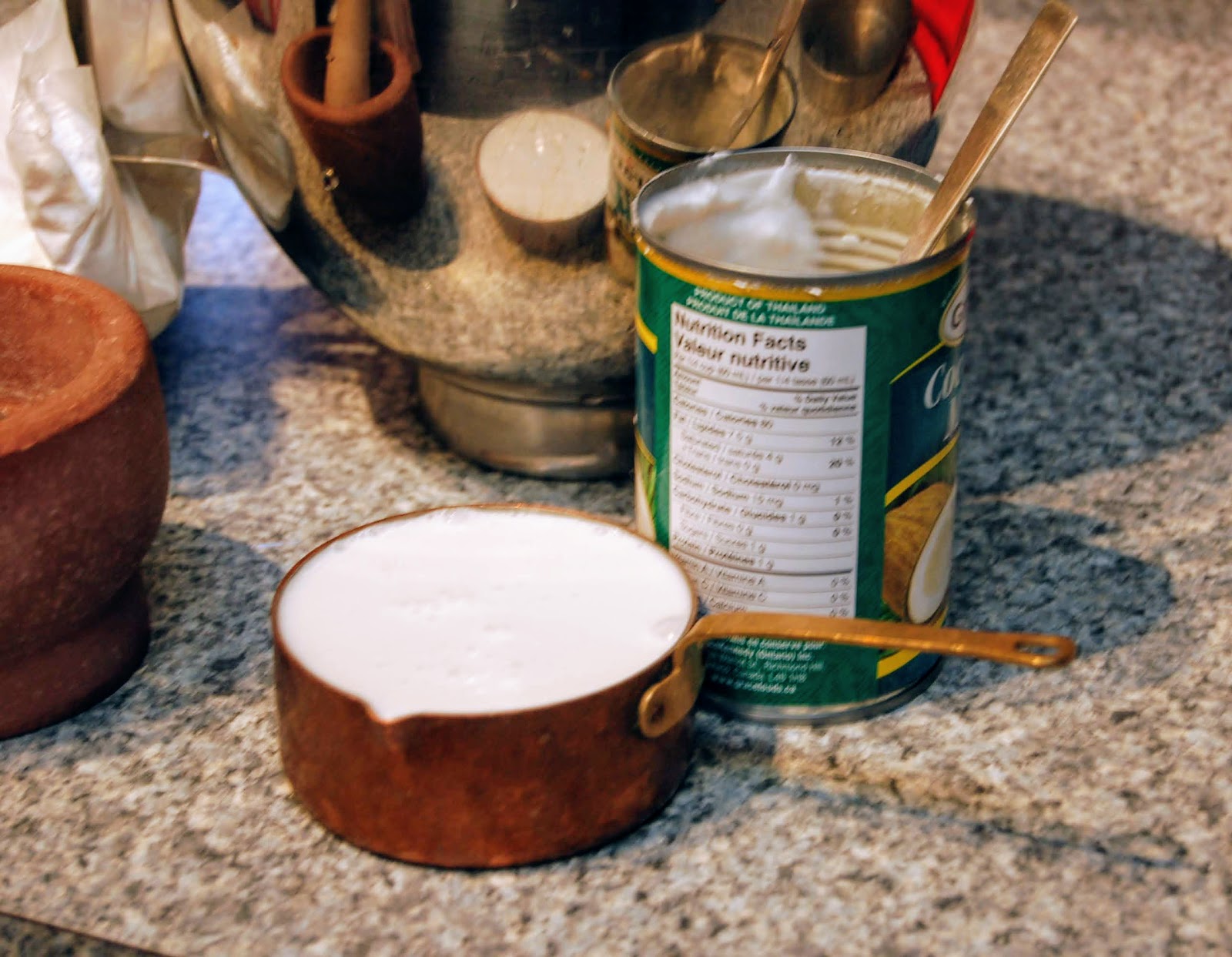
I came across this delectable dessert at Calgary’s Delhi Darbar the other night, and oh, I was impressed.  While theirs was done with dairy cream, I opted for coconut cream for our dairy avoiding friends tonight.
I can’t claim this is vegan though.  I used gelatin to set it, although it’s thick enough I think you could get away without the gelatin, if you are so inclined.

1 cup tinned mango pulp
2 Alphonso mangoes
1 tin coconut milk (400 ml)
1 tablespoon gelatin powder
3 tablespoons Limoncello (or 1 tablespoon lemon juice and extra sugar to taste)
3 tablespoons vanilla sugar (or regular sugar and 1 teaspoon vanilla)
5 green cardamom pods, husked and ground to a fine powder
A few drops of rosewater
rosepetals
pinches of raw sugar crystals


Pour about half a cup of the coconut milk into a bowl, and microwave to get it hot.  Sprinkle the gelatin powder over it, and stir it in till dissolved.  Set aside.
Pour the rest of the coconut milk into a blender, along with the mango pulp, skinned and sliced Alphonso mangoes.  

Two things: 

Don't pitch the mango pulp container in the sink just yet.  Set it aside to use the remaining drops later.

Also, here in Calgary, mangoes are expensive, and not very reliable.  They travel such a distance that they’re sometimes on the feeble side, so I like to hedge my cooking bets with at least some tinned mango pulp from India.  If I’m not using the entire tin, I pour the contents into a container, and keep it safely in the freezer. It’s already sweetened, and packs an excellent flavour. 

I suppose you could make this dessert with only the tinned pulp, but I always like to include something fresh, as I’m sure it’s healthier. 


Turn your blender on liquefy and buzz and then taste for sweetness.  If you have Limoncello, add it now.  If you don’t, race out and buy some.  If this is impossible, add fresh lemon juice and sugar.  (Do not, do not, even think about using bottled lemon juice, or the rancid stuff from the plastic lemons.)  
Vanilla sugar, Limoncello and green cardamom --so fabulous!


Now that you have the best lemon flavours in there, buzz again and test for sweetness.  Add sugar a little at a time, until it tastes fabulous.  Add ground cardamom and a few drops of rosewater, along with the gelatin and warm coconut mixture, and buzz one last time.  
Pour into pretty glasses, decorate with remaining drops of the mango pulp, rose petals and a pinch of sugar crystals, and chill.
Buy dried rosepetals in Indian groceries, or pick your own!